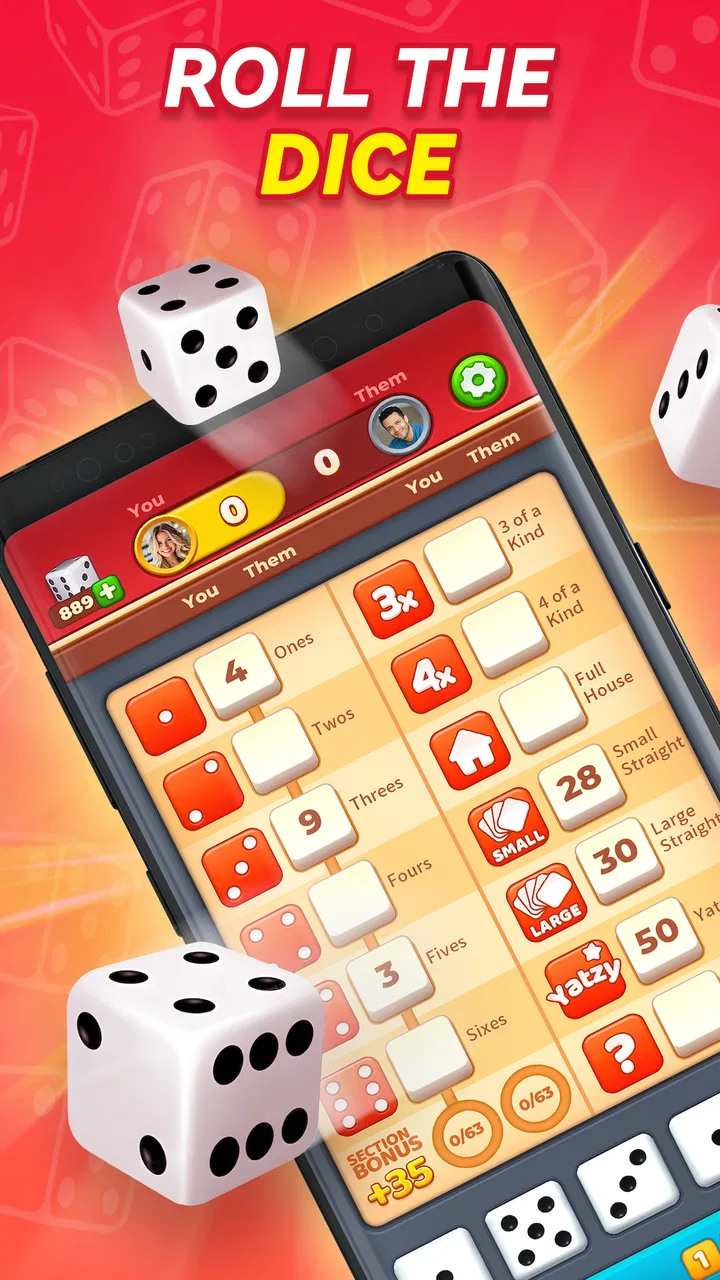
Yatzy GO! Classic Dice Game
- 4.9
- Rating
- 500.00K
- Installs
- Free
- Price

 Analysis by App-foxy
I spent time with Yatzy GO! Classic Dice Game as a casual board game, and my first impression was that it understands why dice games remain so easy to return to. A round can fit into a short break, but the decisions are meaningful enough to stop the experience from feeling like pure luck. You roll, choose how to use the result, and try to build the strongest score from limited opportunities. That familiar loop makes it approachable immediately, while the scoring choices give experienced players something to think about.
This is a free game from Game In Life, aimed at everyone rather than a narrow age group. It belongs to the board-game category, and its store summary presents it as a mix of luck and strategy built around classic dice rolling. That description is simple, but it captures the central appeal: the game is easy to explain, yet a careless scoring decision can affect the rest of a round.
How the free model affects the experience
The most important cost detail is straightforward: the game can be downloaded and played for free. That makes it easy to try without committing money first, which suits a compact dice game particularly well. In-app purchases are available, ranging from $0.99 to $99.99 per item. I would therefore approach the game as a free-access title rather than assuming that every part of the experience has the same value or that spending is necessary.
You May Also Like

 Blood Strike: 2.5 Anniversary
Blood Strike’s Loadouts Turn Every Drop Into a Tactical Gamble
A close look at Blood Strike’s custom loadouts: how fast access to signature weapons reshapes its battle royale rhythm, rewards preparation, and narrows the gap between fights.

 Pandora - Music & Podcasts
Pandora’s Music Is Easy to Start, but Harder to Recover
Pandora’s strength is its low-effort path from a seed to a station. Its weak spot is how much confidence it asks you to place in connection, setup, and quiet recovery.

 8 Ball Pool
 Is Built on Rivalries, Rematches, and Routine
A close look at the rivalries, rematches, shared routines, and unanswered safety questions that turn a quick pool match into a persistent mobile community.

 Samsung Music
’s Quiet Strength Is Playing What You Already Own
Its reach comes less from spectacle than from dependable access to a personal library. That simplicity is both the app’s strongest retention engine and its ceiling.

 AccuWeather: Weather Radar
AccuWeather Review: A Quick, Clear Forecast for Everyday Decisions
For everyday plans, the best forecast is the one you can understand quickly. AccuWeather makes rain timing, radar, and local conditions easy to act on, with a few trade-offs.

 Hill Climb Racing
Why Hill Climb Racing Still Turns Crashes Into One More Run
A tiny car, a bumpy hill and one more upgrade: Hill Climb Racing keeps resurfacing because its simple chaos makes every near-miss feel personal.
More From Our News Desk



That distinction matters because the core attraction is the decision-making loop, not an expensive presentation or a large collection of content that must be unlocked before the game becomes enjoyable. If you like rolling dice, weighing risk, and filling out combinations, the free entry point gives you a fair chance to decide whether the format suits you. If you do not enjoy repeated rounds built around similar scoring choices, paying for optional items would not solve that basic mismatch.
The game has an average rating of 4.9 from around 20K ratings, with about 2.1K written reviews. It has also passed 500K installs, so it is not an obscure experiment with no visible audience. Those figures do not guarantee that every player will enjoy it, but they do suggest that the straightforward format has connected with a substantial group of people. I still recommend judging the purchase options slowly, because a high rating says more about broad satisfaction than about whether optional spending is worthwhile for your particular habits.
There is a useful difference between paying to access a game and choosing to spend inside a free game. Here, the initial barrier is low. Someone can test a few sessions during a commute, while waiting for an appointment, or during a quiet evening without buying anything first. The sensible value question is not “Is the download free?” but “Does the free experience already give me enough reason to keep playing?” For me, the answer is yes when I want a short, focused board-game session, but less so when I am looking for a long campaign or a constantly changing challenge.
The basic rhythm is simple, but the choices are not
A typical round begins with anticipation and quickly becomes a problem of damage control. A promising roll can tempt you to chase a better combination, while an awkward result forces you to decide which scoring opportunity is least painful to sacrifice. That tension is where the strategy lives. The dice create uncertainty, but the player still controls how to respond to it.
My most useful habit was to stop treating every roll as a reason to chase the biggest possible outcome. Sometimes protecting a reliable score is wiser than gambling on a rare combination. This is especially important late in a round, when empty or weak scoring categories leave fewer ways to recover. The game rewards players who can change plans instead of becoming attached to the result they hoped to get.
Another practical tip is to consider the whole score sheet rather than only the current roll. A modest result may fit a category you are unlikely to fill later, while a more exciting combination could be easier to obtain on another turn. That makes the game more thoughtful than its casual appearance suggests. I found that the best decisions were often the least dramatic ones: accepting a safe score, preserving flexibility, and avoiding a desperate final reroll.
Why it works well in everyday play
The short-session design is the strongest everyday benefit. Imagine having ten minutes before leaving for work. A large strategy board game would be inconvenient, and a competitive online game might demand more attention than you can give. This dice game fits that gap naturally. You can start a round, make a few decisions, and put the phone away without needing to remember a complicated story or maintain a long-term build.
It also works for relaxed social situations where people want something to do without learning a heavy rulebook. The familiar structure makes it easier to introduce than a complex tabletop title. A family member who rarely plays mobile games can understand the objective quickly, while a regular board-game player can still think about probability, category timing, and risk management.
At the same time, the compact format can become repetitive. The same basic loop is the reason the game is accessible, but it is also the main limitation. Players who need new maps, evolving characters, narrative rewards, or a deep progression system may find the experience narrow. I would not choose it as my only mobile game if I wanted constant novelty.
Small decisions that improve your results
One non-obvious lesson is that early turns should usually be used to preserve options. It is tempting to lock in the first attractive combination, but an early commitment can make later rolls harder to use. I prefer to keep categories open until the shape of the round becomes clearer, unless a particularly valuable opportunity is already in front of me.
A second lesson is to separate emotional value from scoring value. A visually satisfying roll can feel important even when it does not fit the best available category. If I score based on excitement alone, I often create a worse position for the next turn. Treating each roll as a resource rather than a reward helps keep the session strategic.
A third useful approach is to plan for an imperfect finish. Not every round will produce the combination you want, and waiting for a miracle can turn a manageable position into a poor one. When the remaining categories are awkward, I look for the least damaging placement instead of trying to rescue the entire score. That mindset makes losses less frustrating and helps me make better decisions under pressure.
These habits also explain why the game can appeal to different skill levels. A new player can simply learn the categories and enjoy the uncertainty. Someone more experienced can think about probability and opportunity cost without needing a completely different ruleset. The depth is not endless, but it is enough to make familiar rounds feel slightly different from one another.
Where the value is strongest
The best value comes from repeatable convenience. This is a game I can open when I want a focused activity rather than an endless feed. A single round gives me a clear beginning, middle, and end, which is satisfying in a way that many free mobile games are not. There is no need to invest a large block of time before the game becomes interesting.
It is also a good choice for people who enjoy traditional board games but want something lighter on a phone. Compared with a complex digital adaptation, this experience is easier to pick up and less demanding to organize. Compared with a basic random dice roller, it gives the player meaningful choices and a reason to care about each result. That middle ground is its strongest position.
For players who value social competition, the appeal depends on the way they prefer to play. The scoring format naturally invites comparison and rematches, so it can support friendly rivalry. However, anyone seeking a rich multiplayer community, elaborate matchmaking, or a large competitive ecosystem should examine those expectations carefully before spending. The game’s confirmed identity is a classic dice board game, not a replacement for a full competitive platform.
Trade-offs to consider before installing
The free price makes trying it easy, but the presence of in-app purchases means I would avoid treating every optional offer as automatically good value. A low-cost item may feel harmless, while the upper end of the purchase range is a much more serious commitment for a simple dice game. My advice is to enjoy the basic experience first and decide whether any added purchase genuinely improves the way you play.
The age rating of Everyone makes the game broadly suitable as a casual board-game option. That does not mean every household will have the same opinion about optional spending, so families may still want to set clear purchase boundaries. The game’s accessible rules are a strength, but free-to-play design can make budgeting more important than it would be with a one-time paid game.
Another trade-off is depth versus immediacy. The rules are approachable because they do not bury the player in systems. That makes the first session comfortable, but it also means the experience may not satisfy someone who wants a campaign, detailed customization, or a large strategic sandbox. I see this as a focused pastime, not a substitute for a full tabletop collection.
The current version is 3.4.6.1, and the game supports Android 7.0 or later. That gives it a practical place on many older compatible devices, although the actual comfort of play will still depend on the phone or tablet being used. I would check the device requirement before trying to install it on an especially old Android device, particularly if the game is intended for a family member’s handset.
Who should give it a chance
I would recommend it to anyone who likes Yahtzee-style decision-making, classic board games, or short probability-based challenges. It is especially suitable for players who enjoy making the best of an imperfect roll. You do not need to memorize a complicated system, and you can begin experimenting with better choices almost immediately.
It is a strong fit for casual players who want something more engaging than a passive time-filler. The game gives every turn a small question to answer: should I protect a safe result, chase a better one, or accept a weak score to preserve future options? Those questions are modest, but they are enough to make a spare few minutes feel purposeful.
I would also suggest it to families or friends who want a simple shared activity. Because the concept is familiar, the learning curve should not get in the way of conversation. It can sit comfortably beside a coffee break or a relaxed evening rather than demanding the full attention of everyone in the room.
Who may be better served elsewhere
I would skip it if your priority is constant content variety. Players who lose interest when the same core rules repeat may find the long-term appeal limited. A larger strategy game, a narrative adventure, or a more feature-heavy board-game adaptation would be a better choice for someone who needs progression and surprise in every session.
I would also be cautious if you are uncomfortable with in-app purchases in free games. Even though the download costs nothing, the available purchase range means this is not the same as a simple one-time paid app. If you prefer knowing the full cost upfront, a premium board game with no optional spending may offer a clearer value proposition.
Finally, players who want a highly competitive online environment should not choose this solely because it is a dice game. The classic format provides the foundation, but serious competitive needs can be better met by a title built specifically around ranked play, organized matches, or a broader multiplayer structure.
My final recommendation
After using it as a quick board-game break, I see Yatzy GO! as a sensible free download for players who enjoy simple rules with room for careful decisions. Its value comes from being immediately playable, easy to revisit, and more thoughtful than a purely random dice app. The game does not need elaborate decoration to make a roll feel important; the scoring choices do that work.
I would start without spending, learn how the scoring decisions fit my own style, and only then consider whether an optional purchase has a clear purpose. For a free casual game, it delivers a focused experience that can fit naturally into everyday routines. My buy-or-skip verdict is a clear try: choose it if you want classic dice strategy in short sessions, but skip it if you need a deep progression system, extensive variety, or a fixed all-inclusive price.
Game In Life has kept the concept approachable, and the broad Everyone rating reinforces that accessible character. The game is not trying to be every kind of board game at once, which is both its strength and its boundary. If you enjoy making smart choices with imperfect rolls, the free entry point makes Yatzy GO! worth trying; if the repeated format already sounds limiting, no purchase is likely to change your mind.
FAQs for Yatzy GO! Classic Dice Game
01What is Yatzy GO! Classic Dice Game?
Yatzy GO! Classic Dice Game is a digital version of the traditional dice game, Yatzy. Players roll five dice and aim to achieve specific combinations to earn points. With its user-friendly interface and engaging gameplay, it's suitable for both casual players and Yatzy enthusiasts. Available for both Android and iOS, it offers various modes for solo and multiplayer experiences.
02Are there any in-app purchases or ads in Yatzy GO! Classic Dice Game?
Yes, Yatzy GO! Classic Dice Game includes both in-app purchases and advertisements. Players can opt to purchase additional features, such as new themes or power-ups, to enhance their gaming experience. While ads are present, they can usually be removed through a one-time purchase. Checking the app store description for detailed pricing information is recommended.
03Does Yatzy GO! Classic Dice Game require an internet connection?
Yatzy GO! Classic Dice Game can be played offline, allowing users to enjoy the game without an internet connection. However, certain features, like multiplayer modes or online leaderboards, require connectivity. Players who prefer solo gameplay can fully enjoy the app without being connected to the internet.
04How does the multiplayer mode work in Yatzy GO! Classic Dice Game?
In the multiplayer mode of Yatzy GO! Classic Dice Game, players can connect with friends or other users worldwide. The game supports both real-time matches and turn-based play, allowing flexibility in how players engage with others. Leaderboards and social features enhance the competitive aspect, making it a great way to challenge friends.
05Are there any tips for beginners playing Yatzy GO! Classic Dice Game?
New players should start by familiarizing themselves with the scoring combinations, such as Full House or Small Straight. Focus on maximizing scores by prioritizing high-value combinations early in the game. Practice mode is useful for learning strategies without pressure. Additionally, utilizing rerolls wisely can significantly influence the outcome of a match.
Pros
- Simple
- intuitive interface design.
- Quick game setup and play.
- Variety of game modes available.
- Offline play option included.
- Supports multiplayer matches.
Cons
- Occasional ads can disrupt gameplay.
- Limited customization options.
- In-app purchases for premium features.
- Requires frequent updates.
- Battery consumption could be improved.

Yatzy GO! Classic Dice Game
Gallery